
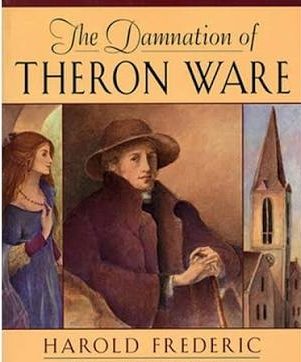
The Damnation of Theron Ware
Free to read
 ✓
Author
Harold Frederic (1856–1898) was an American novelist and journalist whose fiction combined social observation, psychological insight, and a strong interest in religious and political questions. Although his literary care
Harold Frederic (1856–1898) was an American novelist and journalist whose fiction combined social observation, psychological insight, and a strong interest in religious and political questions. Although his literary career was relatively brief, he produced several notable works and is remembered particularly for his realistic portrayal of American life in the late nineteenth century. Frederic was born on August 19, 1856, in Utica, New York. His father, John M. Frederic, was a photographer who died when Harold was young, leaving his family in difficult financial circumstances. Frederic received a relatively modest formal education and began working at an early age, developing his skills largely through self-education and extensive reading. As a young man, Frederic became interested in journalism and worked for several newspapers in New York State. His talent as a reporter and editor eventually brought him to the Utica Herald, where he became an important member of the editorial staff. His journalistic experience gave him a close knowledge of politics, social conditions, and the everyday lives of ordinary Americans. In 1884, Frederic moved to England after becoming the London correspondent for the New York Times. He spent much of the rest of his career in Europe, reporting on British politics and society. His years in England broadened his perspective and provided material for some of his later literary work. Frederic began publishing fiction during the 1880s. His early novels included The Copperhead (1893), a historical novel set against the American Civil War, and In the Valley (1890), which explored religious and social conflicts in an American community. His writing was influenced by the growing tradition of literary realism and by his own experience as a journalist. His best-known novel, The Damnation of Theron Ware, was published in 1896. The novel follows Theron Ware, an ambitious Methodist minister whose intellectual curiosity and encounters with more sophisticated people gradually undermine his religious convictions and personal stability. The book examines faith, intellectual ambition, hypocrisy, and the tension between traditional beliefs and modern thought. Frederic's fiction is notable for its detailed depiction of communities and its complex treatment of human motives. Rather than presenting characters simply as good or evil, he explored the psychological and social pressures that shaped their decisions. His journalistic eye also contributed to his ability to portray institutions and communities with considerable realism. His personal life became increasingly complicated during his years in England. Frederic lived with Kate Lyon, with whom he had several children, although he was still legally married to Grace Griffith. His relationships and unconventional domestic arrangements attracted controversy, particularly in the conservative social environment of the period. Frederic's health deteriorated in the late 1890s. He died suddenly on October 19, 1898, in London, at the age of forty-two, after suffering a stroke. His death brought an early end to a promising literary career. Harold Frederic is remembered today chiefly for The Damnation of Theron Ware, a novel that has retained its reputation for its sophisticated treatment of religious doubt and intellectual transformation. His work occupies an interesting place in American realism, standing at the intersection of journalism, social criticism, and psychological fiction.
Free to read
Harold Frederic's work is in the public domain — free for everyone, forever.
Payments are handled by Stripe. You can see everything you have given on your purchases page.