
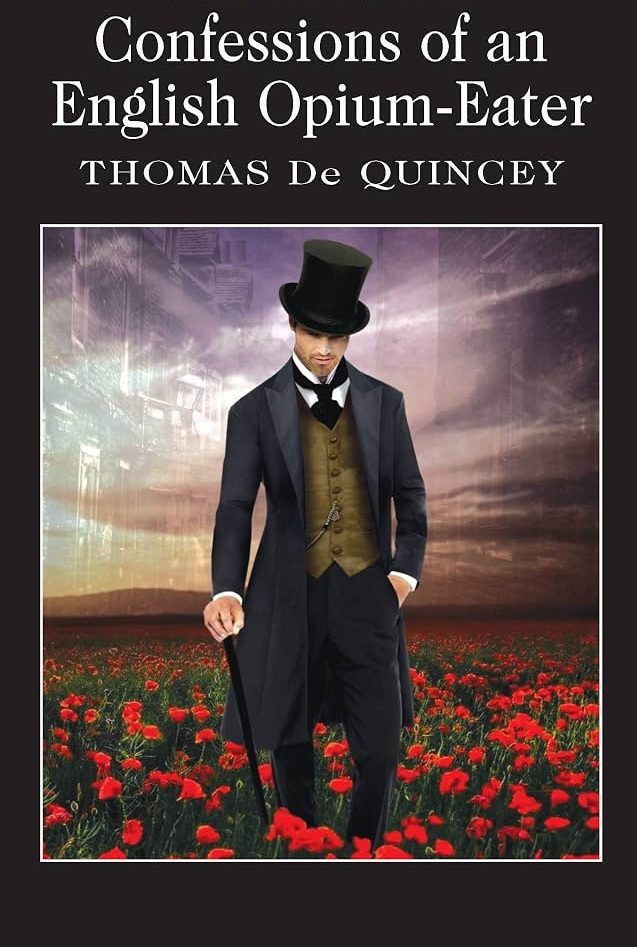
Confessions of an English Opium-Eater
Free to read
 ✓
Author
Thomas De Quincey (1785–1859) was an English essayist, critic, and writer best known for his highly personal and influential prose. Born in Manchester, he showed an early interest in literature and developed a lifelong f
Thomas De Quincey (1785–1859) was an English essayist, critic, and writer best known for his highly personal and influential prose. Born in Manchester, he showed an early interest in literature and developed a lifelong fascination with philosophy, poetry, religion, and the workings of the human mind. His writing is noted for its vivid imagery, psychological insight, and distinctive mixture of autobiography, literary criticism, and philosophical reflection. De Quincey is most famous for Confessions of an English Opium-Eater (1821), a pioneering autobiographical work describing his experiences with opium addiction, dreams, suffering, and attempts at recovery. The book attracted considerable attention because of its frank treatment of addiction and its elaborate descriptions of altered states of consciousness. It also helped establish De Quincey as an important figure in the development of autobiographical and psychological literature. Throughout his career, De Quincey wrote extensively for magazines and literary journals. His essays covered subjects ranging from philosophy and economics to history, crime, literature, and religion. Among his notable works are Suspiria de Profundis, The English Mail-Coach, and On Murder Considered as One of the Fine Arts. His prose often combines intellectual argument with imaginative storytelling, irony, and elaborate reflections on memory and emotion. De Quincey was closely associated with the literary world of the Romantic period and knew or encountered several prominent writers, including William Wordsworth, Samuel Taylor Coleridge, and Charles Lamb. He eventually settled in Edinburgh, where he spent much of his later life. His financial difficulties and dependence on opium contributed to a turbulent personal life, but they also became an important part of the literary identity he created through his autobiographical writing. Thomas De Quincey died in Edinburgh in 1859. His work occupies an important place between Romanticism and Victorian literature, particularly for its exploration of dreams, memory, addiction, and the inner life. His richly imaginative prose influenced later writers interested in psychological experience and the possibilities of autobiographical literature.
Free to read
Thomas De Quincey's work is in the public domain — free for everyone, forever.
Payments are handled by Stripe. You can see everything you have given on your purchases page.